Dalberg uses cookies and related technologies to improve the way the site functions. A cookie is a text file that is stored on your device. We use these text files for functionality such as to analyze our traffic or to personalize content. You can easily control how we use cookies on your device by adjusting the settings below, and you may also change those settings at any time by visiting our privacy policy page.
India’s air pollution challenge is both urgent and deeply structural. Affecting all 1.4 billion residents, it poses a dual threat to public health and economic growth, costing the country an estimated $95 billion annually, or nearly 3% of GDP. Yet this crisis also presents an opportunity: solving for air quality can unlock large-scale investment, job creation, and climate co-benefits across sectors.
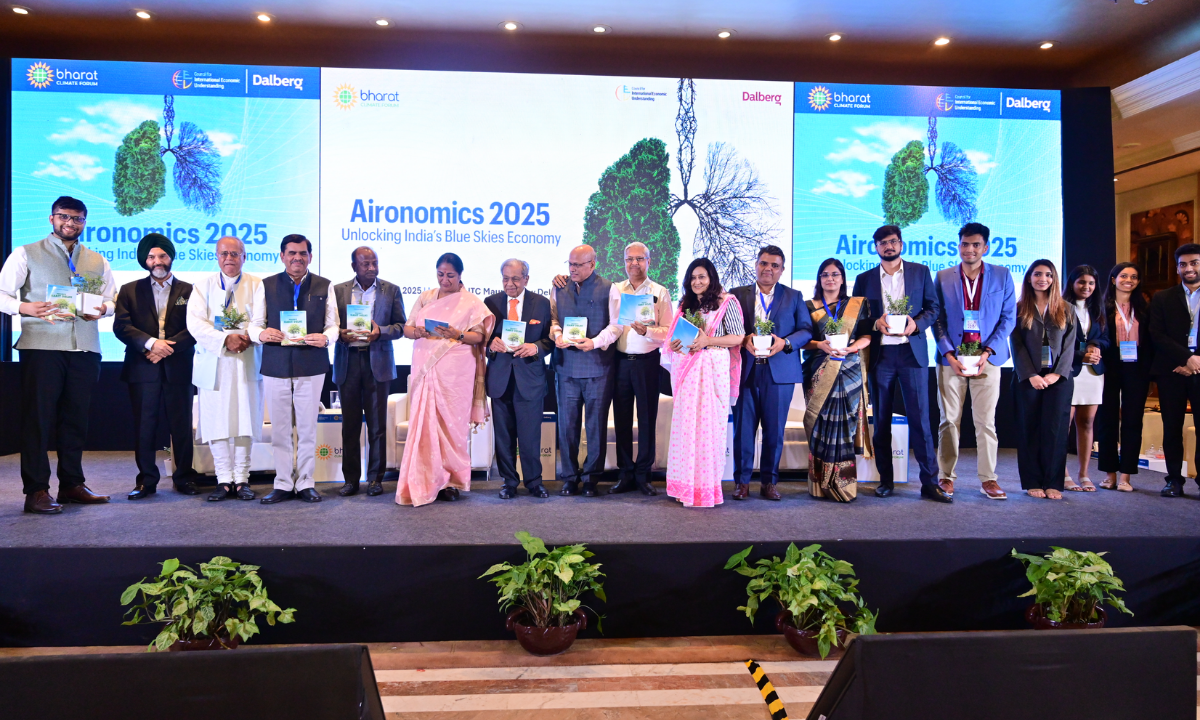
Aironomics 2025 offers a new lens: one that sees clean air as a lever for growth, innovation, and equity. Developed by Dalberg and the Council for International Economic Understanding (CIEU), the report reimagines air quality action as a driver of India’s long-term development goals, linking it with job creation, green manufacturing, and resilient cities.
From electrifying transport to scaling biogas and waste infrastructure, the opportunities are tangible:
- Delhi-NCR could reduce pollution by one-third through focused interventions, while unlocking ~$4 billion in capital investment.
- India’s EV industry, expected to touch $250 billion by 2030, could create over 5 crore new jobs.
- Compressed biogas plants and recycling hubs can divert thousands of tonnes of daily waste, powering circular economies and local livelihoods.
The report also shows how pollution, climate change, and biodiversity loss share the same root causes and can be tackled together with sectoral interventions. Cleaner cookstoves, smarter waste systems, and greener power plants can simultaneously reduce emissions, protect forests, and improve lives. The report also emphasizes the importance of airshed-level coordination, particularly across the Indo-Gangetic Plain, where pollution travels across state lines. With regional cooperation and multi-sectoral strategies, India can design systems that deliver impact beyond jurisdictional boundaries.
Despite growing momentum, three major barriers remain:
- Fragmented governance across ministries and weak enforcement capacity
- Insufficient financing: Only $0.3 billion in air quality funding between 2018–2022
- Low public awareness and behavior change, compounded by poor data availability
Aironomics 2025 brought together policymakers, industry leaders, philanthropies, and civil society to co-create actionable roadmaps and mobilize investment. The summit highlighted promising models from SWaCH (Solid Waste Collecting and Handling) systems in Pune to China’s incentive-based funding to hart next steps for India to lead globally on climate and air quality. Read the full report to know more.

Jagjeet Sareen
Partner, Dalberg Advisors

Shruti Goyal
Partner, Dalberg Advisors
Related Articles