
Dalberg uses cookies and related technologies to improve the way the site functions. A cookie is a text file that is stored on your device. We use these text files for functionality such as to analyze our traffic or to personalize content. You can easily control how we use cookies on your device by adjusting the settings below, and you may also change those settings at any time by visiting our privacy policy page.
Reducing poverty through the creation of new economic opportunities remains one of the most pressing challenges facing Latin America—and Colombia in particular. Despite years of social investment and economic growth, inequality and exclusion persist. As of 2023, multidimensional poverty in Colombia stands at 12.1%, rising to 25.1% in rural areas[1], facing barriers not only in income but also in education, healthcare, and access to basic services.
The region’s commitment to ending poverty[2] has faced mounting obstacles. The 2020s risk becoming another “lost decade” for progress[3], as overlapping crises such as the COVID-19 pandemic, inflation, climate shocks, and migration pressures have stalled or reversed gains[4]. At the same time, public spending on social outcomes is increasingly constrained[5]. In Colombia and across the region, governments are grappling with fiscal deficits and growing debt[6], limiting their ability to respond at scale.
As public resources come under strain, a new question emerges: How can other sectors, particularly the private sector, step up to protect and accelerate progress?
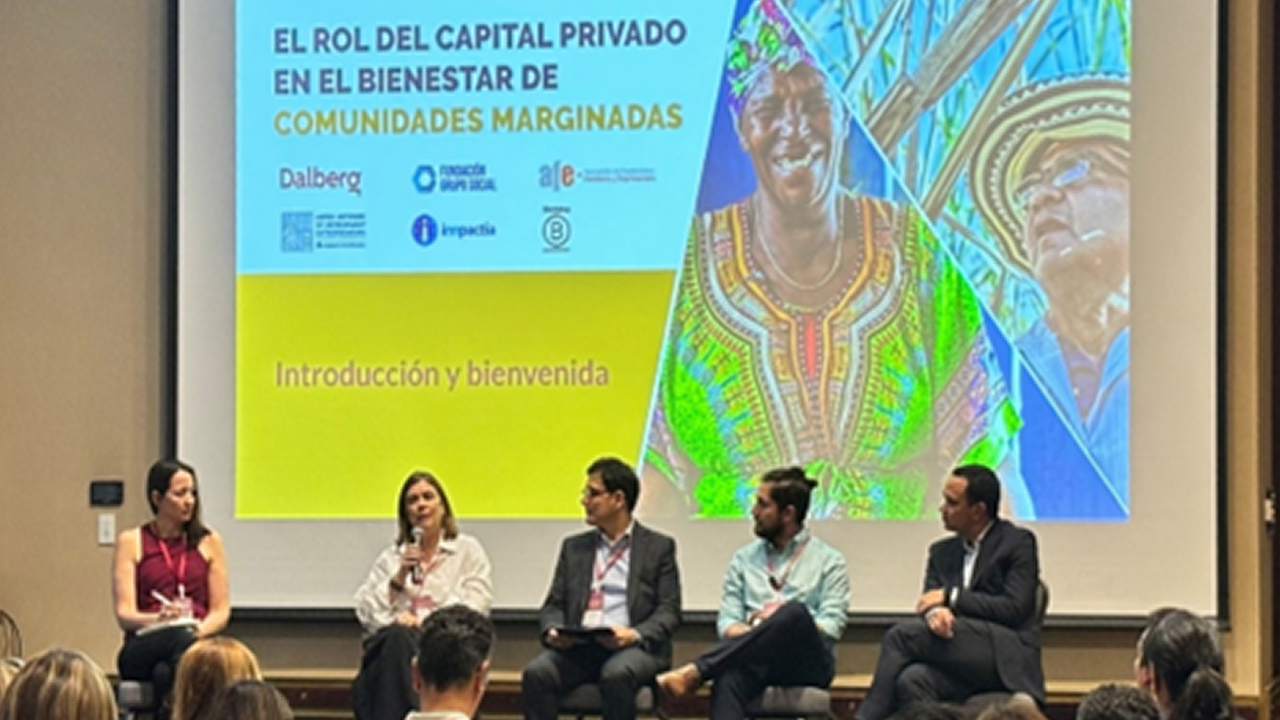
To explore this question, earlier this year, Dalberg partnered with Sistema B and Fundación Grupo Social to convene more than 30 social impact leaders and B corps[7] in Medellín, Colombia. Fundación Grupo Social to convene more than 30 social impact leaders and B corps in Medellín, Colombia. The exchange revealed valuable insights across the ecosystem, balancing between short-term business goals and long-term community needs. This piece draws from those discussions to share insights on how the private sector in Latin America can rise to meet this moment.
The key takeaway: The private sector has the power to shift from profit-only engines to architects of inclusive growth, where solving poverty challenges is part of the business model, not just the mission statement.
The private sector in Latin America has always been indirectly responsible for poverty reduction. Per latest figures available, private enterprises generate over 66% of formal jobs in the region[8], although nearly half of all workers remain employed informally[9]. The region has also seen notable philanthropic contributions from corporations. For instance, corporate foundations represent approximately 50% of all foundations in the region, with higher concentrations in countries like Brazil (64%) and Colombia (68%)[10]. Beyond these roles typically played by the private sector, an immediate change in approach is needed to significantly reduce global poverty.
At this gathering, one message came through clearly: the private sector must play a more central, strategic role in addressing poverty and inequality across Latin America. The discussions moved beyond traditional corporate philanthropy or short-term campaigns, focusing instead on how businesses can embed impact into their everyday decisions and long-term growth strategies.
In Colombia and across the region, this shift is both necessary and promising. Rather than treating social impact as a parallel initiative, companies are beginning to see that aligning business goals with community needs can unlock new forms of value—for society and the bottom line. This shift is not just socially meaningful; it also makes business sense. Companies that align with the needs of their communities and ecosystems are more resilient, more relevant, and better positioned for long-term success.
Five Takeaways on Embedding Impact into Core Business Strategies
From this discussion, there were five key lessons that businesses should consider to make the shift toward deeper, more sustainable impact:
- Design with communities, not for them. Engaging early with communities helps businesses build trust, uncover unmet needs. This approach leads to solutions that are not only more relevant and widely adopted, but also create deeper, longer-term value for both communities and the business. By addressing unmet needs in underserved communities, companies can both expand their customer base and tackle social challenges. Alianza para el Desarrollo exemplifies a community-centered co-creation model, working hand-in-hand with local populations to identify challenges, set priorities, and design solutions that respond to real and evolving needs.
“The critical element of Alianza para el Desarrollo is the way they focused on the territories they wanted to help and started from there, by asking what their true needs were.”
Aura Lucía, AFE
- See employees as part of the social ecosystem. When businesses prioritize employee well-being, especially in regions where workers face systemic barriers, they not only improve lives but also strengthen long-term performance.
“Employees are a company’s greatest asset, presenting a significant opportunity to enhance their well-being while strengthening the business.”
Alejandra Pardo, ConConcreto
- Partner to scale smarter. Fostering partnerships and collaboration helps mitigate risk and expand reach. Cross-sector collaboration is essential for sharing expertise, resources, and responsibility to achieve greater impact.
“We need to do more. Many organizations do impactful work but aren’t talking to each other.”
Aura Lucía, AFE
- Monitor progress with high fidelity and low investment. Implementing simple yet effective measurement frameworks to track outcomes ensures accountability and continuous improvement without excessive costs.
“One of the biggest gaps in the impact sector is demonstrating measurable outcomes. Companies must focus on delivery and proving results.”
Juan Carlos Lozano, Innpactia
- Leverage innovation and meet communities where they are. Technology and innovative tools enable businesses to reach underserved populations more effectively. They also streamline operations, making impact efforts more scalable and sustainable. In Colombia, Fundación Grupo Social exemplifies this by embedding purpose at the core of its strategy and using technology-enabled, adaptive solutions to meet communities’ needs in moments of crisis—building lasting trust and loyalty among its clients.
“During the pandemic, Fundación Grupo Social chose to act like a true friend to its clients—offering automatic payment relief, absorbing losses in the short term, and trusting that people would come back stronger. By the end of the crisis, 96% of customers had resumed payments, and the bank’s long-term performance rebounded.”
Juan Carlos Gómez, Fundación Grupo Social
The Opportunity is Now—the Private Sector has a Pivotal Role in Protecting the Continuity of Impact
To truly drive change, businesses in Latin America must make social impact a core part of their strategy. This means integrating impact into decision-making, operations, and financial models—not as a compliance requirement, but as a pathway to long-term value and resilience. Companies that take this step are better positioned to strengthen their performance while contributing to more inclusive and sustainable economies.
Building on this foundation, businesses can also move beyond isolated initiatives. While philanthropic efforts and short-term campaigns have value, they are most effective when aligned with broader business goals and grounded in community needs. By embedding impact more deeply, companies can unlock more consistent, scalable, and transformative results.
The opportunity is clear for the private sector to step up—now is the time to act and safeguard our communities and the change we hope to see.
[1] DANE, Pobreza Multidimensional en Colombia, 2023
[2] United Nations, Goal 1: End poverty in all its forms everywhere, 2024
[3] Stemmler, et. Al., “The polycrisis behind a lost decade of poverty reduction”, 2024
[4] World Bank, Poverty, 2024
[5] The Guardian, Dismay as UK poised to cut funding for global vaccination group Gavi, 2025
[6] Portafolio, En cuánto se proyecta el hueco de recaudo tributario en Colombia al cierre del 2024, 2024
[7] B Corps are companies which are certified for meeting high standards of performance, accountability, and transparency across areas such as employee benefits, charitable giving, and supply chain practices.
[8] WorldBank, Women in the private sector in Latin America and the Caribbean, 2014
[9] ILO, Labour Overview, 2024
[10] Harvard Kennedy School, Global Philanthropy Report, 2023
Fabiola Salman
Partner & Latin America practice lead, Dalberg Advisors
Juan Pablo Jimenez
Associate Partner & Colombia presence lead, Dalberg Advisors
Juan Felipe Quintero
Associate Partner & Colombia & Central America presence lead, Dalberg Advisors
Related Articles