Dalberg uses cookies and related technologies to improve the way the site functions. A cookie is a text file that is stored on your device. We use these text files for functionality such as to analyze our traffic or to personalize content. You can easily control how we use cookies on your device by adjusting the settings below, and you may also change those settings at any time by visiting our privacy policy page.
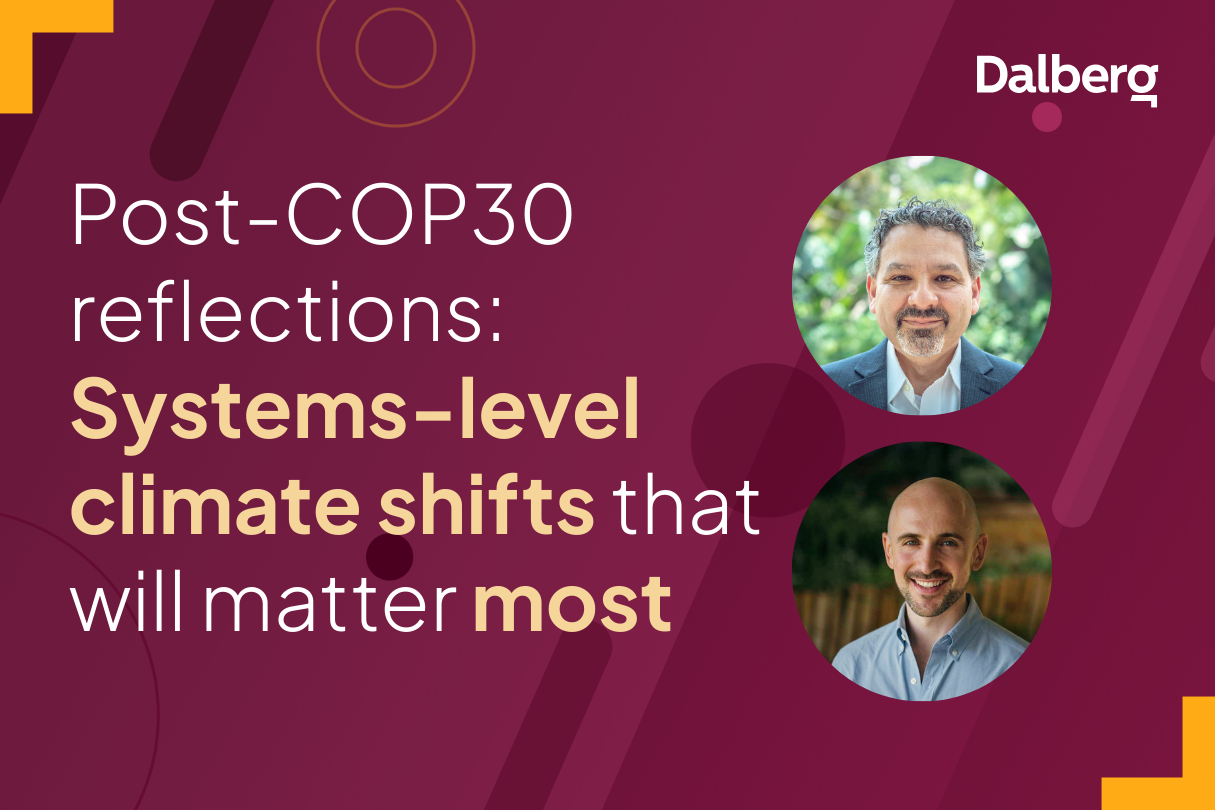
With #COP30 now behind us, much of the conversation has shifted toward what countries, companies, and financiers can realistically deliver in the coming year. The themes in this clip mirror the challenges we see every day: translating climate ambition into plans that are workable, financed, and grounded in how people actually live. We’re seeing three needs come up repeatedly in our work:
1. Implementation requires whole-economy coordination. Climate plans only hold if they connect energy, agriculture, industry, transport, and community resilience in one coherent pathway, not in isolated sector strategies.
2. Finance must be designed around real constraints. Blended finance, supply-chain transitions, and investment pipelines work only when they reflect how capital providers, governments, and local actors make decisions in practice.
3. Community insight has to be part of the solution design. Solutions scale when they reflect the lived realities of the people affected and the institutions responsible for delivering them.
As post-COP work begins, these are the questions shaping our engagements, from national climate action planning to regenerative agriculture sourcing to household energy access. Watch a short reflection from leaders in our Climate and Environment Practice, Oren Ahoobim and Jeffrey Berger, on the systems-level shifts that will matter most.
Watch now: YouTube
Related Articles